Working With a Personal Trainer When You Have Arthritis
By Johnny Barhoumeh
Arthritis, Strength, Northbrook
Working With a Personal Trainer When You Have Arthritis: What to Expect in Northbrook
Yes, you can train with arthritis, and for many people a good coach makes it easier. The key is finding one who adjusts the work to your joints, and who works alongside your doctor or physical therapist instead of around them.
If you have arthritis, you have probably heard two opposite messages. One says rest the joint. The other says push through it. Neither is much help on a Tuesday morning when your knees are stiff and you are trying to decide whether to exercise at all. This post explains what a sensible arthritis-aware training plan looks like, what to ask a trainer before you book, and where a trainer's job ends and your medical team's job begins.
This article is educational and not medical advice. Consult your physician or physical therapist before starting any exercise program.
Why Do So Many People With Arthritis Stop Exercising?
Most people stop because it hurts, or because they are afraid it will hurt. That is a reasonable fear. A bad workout can leave a sore joint sorer for days, and one bad experience is enough to keep someone on the couch for a year.
The trouble is that stopping tends to make everyday life harder. Stairs, getting out of a low chair, and carrying groceries all take strength, and strength fades when you stop using it. Many people we meet in Northbrook are not looking for a big transformation. They want to keep gardening, walking the dog, playing with grandkids, or getting back on the golf course without dreading the next morning.
Arthritis is also not one thing. Osteoarthritis, rheumatoid arthritis, and other types behave differently, and your own joints have their own history. That is why a generic class rarely works well, and why your doctor's guidance comes first.
What Should a Trainer Do Differently for Arthritis?
A good trainer changes the plan around you. A few things we pay attention to at our Northbrook studio:
- Range of motion you can own: We train through the range where your joint feels stable and comfortable, and widen it slowly over weeks. We do not force depth because a chart says a squat should go lower.
- Load that builds gradually: Strong muscles around a joint share the work. We add weight in small steps and watch how you respond over the next day or two, not just during the session.
- Exercise selection: If a movement bothers a joint, we look for a version that does not. A box squat, a supported split stance, a cable row, or a leg press can often stand in for movements that hurt.
- Warm-up that matches the day: Stiff mornings and cold weather change how joints feel. The warm-up changes with them.
- Rest and pacing: Longer rests between sets and fewer total sets are normal choices, especially early on.
📌 Key Takeaway: A joint that hurts a little and settles within a day is a different signal from one that swells, locks, or hurts more the next morning. A coach should teach you to tell the difference and adjust when it happens.
Is 1-on-1 or Semi-Private Better for Arthritis?
It depends on how your joints behave and how much guidance you need. One-on-one sessions give the coach your full attention, which helps if your symptoms change from week to week or you are still learning what your body tolerates. Semi-private sessions with two to four people suit clients who already know their limits and want company, and they cost less per session, starting at $50.
Group fitness is not something we offer right now, and for most people with arthritis that is fine. Fast-paced classes with a room full of people leave little room for a coach to change an exercise for your knee.
Many clients start one-on-one for a few weeks and move to semi-private once the routine is settled. If you are not sure, the free intro session is a low-pressure way to find out.
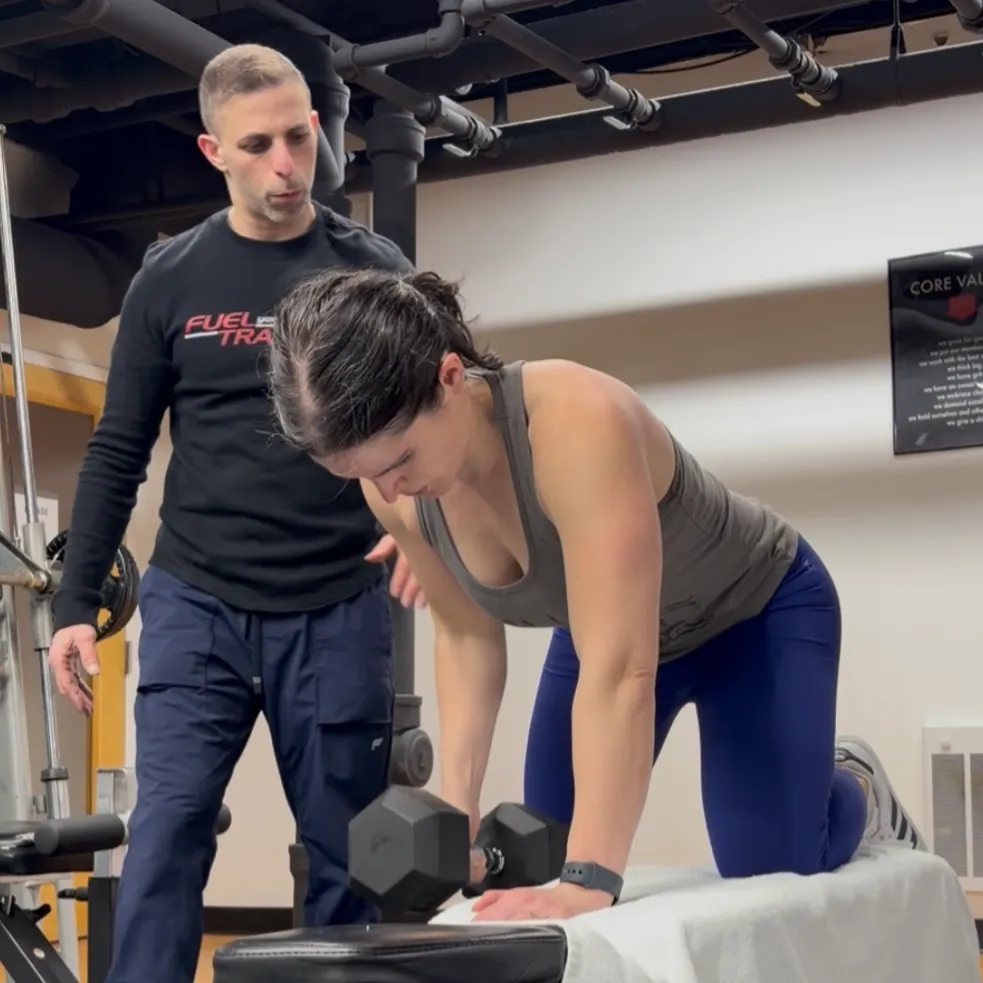
One-on-one coaching at our private studio at 1430 Paddock Dr in Northbrook.
Where Does a Trainer Stop and Your Medical Team Start?
This line matters. A personal trainer does not diagnose arthritis, treat it, or prescribe rehab. Your physician decides whether exercise is appropriate and can tell you about any limits. A physical therapist can assess a specific joint and treat pain or loss of function.
We see our role as the step after physical therapy, or alongside it when your therapist agrees. If you have had a recent flare, a new injury, or surgery, get clearance first. If you are seeing a physical therapist now, ask them what to avoid and bring that list to your first session. We would rather work from their notes than guess.
⚠️ Warning: Stop and contact your doctor if you have sudden swelling, a hot or red joint, pain that wakes you at night, numbness, or a joint that gives way. Those are not signs to train through.
We do not claim that training cures arthritis or heals a joint. What we can honestly offer is careful coaching that helps you build strength and confidence in a way your medical team is comfortable with.
What Should You Ask Before You Hire a Trainer?
Ask these questions, and pay attention to how the trainer answers:
- "How do you adjust exercises for sore joints?" You want specific examples, not a promise that everything is "low impact."
- "Will you talk to my doctor or therapist?" A good trainer says yes and welcomes it.
- "What happens if I have a bad day?" The answer should be that the session changes, not that you push through.
- "How do you track progress?" Look for measures like weight lifted, steps climbed, or how you feel getting out of a chair, not just the scale.
💡 Pro Tip: Write down your best and worst times of day for your joints. Booking sessions when you feel best often makes the first month easier.
If you want to see how we handle related situations, our recent post on exercise for osteopenia for women over 50 covers a similar approach to building strength safely.
What Does a First Session Look Like?
Johnny Barhoumeh, our owner and head coach, starts with a conversation. Which joints bother you? What has your doctor or therapist said? What do you want to be able to do in six months? Then we look at how you move: getting up from a chair, a light squat, a hinge, a push, and a pull. We watch, ask questions, and note what feels good and what does not.
You leave with a plan for the next few sessions, not a sales pitch. The studio is private and appointment only, so there is no crowded floor and nobody watching you figure it out.
We do not publish a one-on-one rate here. Call us and we will explain the options.
Summary
- Get clearance first: Talk to your physician or physical therapist before you start.
- Expect adjustments: A good plan changes range, load, and exercise choice to fit your joints.
- Judge by the next day: How you feel 24 to 48 hours later tells you more than how you feel mid-set.
- Pick the format that fits: One-on-one gives the most attention; semi-private costs less and works well once you know your limits.
- Know the limits: Trainers coach strength. Doctors and therapists diagnose and treat.
Ready to Talk It Through?
Your first visit is free, and we will work from whatever your doctor or therapist has told you. Book your free intro session or call us at (312) 735-1010. We are at 1430 Paddock Dr, Northbrook, IL 60062, and we welcome clients from Glenview, Northfield, Deerfield, Wilmette, Winnetka, Glencoe, and Highland Park.