Strength Training With a Herniated Disc
By Johnny Barhoumeh
Herniated Disc, Strength Training, Northbrook
Strength Training With a Herniated Disc: How to Rebuild Back Strength After Your Doctor and Physical Therapist Clear You
Yes, many people with a herniated disc can lift weights again, but only after a physician or physical therapist says it is safe, and the first sessions should be slow and closely coached. Our personal training in Northbrook picks up where physical therapy leaves off.
You have an MRI report with the word "herniation" on it. Maybe you also have a leg that tingles, a back that locks up when you bend, and a vague fear that one wrong move will make it worse. You want to get strong again. You do not know what you are allowed to do. This article walks through how we think about that, so you can ask better questions of your doctor and of any coach you meet.
📌 Key Takeaway: This is educational information, not a treatment plan. We do not diagnose or treat disc problems. We build strength for people whose medical team has already cleared them to train.
What a herniated disc actually is
The discs in your spine sit between the vertebrae. Each one has a firmer outer ring and a softer center. A herniation happens when some of that center pushes through the outer ring. Sometimes it irritates a nearby nerve. That is why a disc problem in your lower back can show up as pain, numbness, or weakness in your buttock or leg.
Not every herniation causes symptoms, and not every back pain with a herniation on the scan comes from the herniation. This is one reason your own physician matters. A scan describes structure. It does not tell anyone how you will respond to a squat. Your doctor and physical therapist can sort out what is going on in your case.
Where a strength coach fits
Physical therapy comes first. A good therapist figures out which movements bother you, calms things down, and teaches you the basics of moving safely. Many people then get discharged with a handful of home exercises and a pat on the back. That is the gap.
A coach works in that gap. The goal shifts from "feel better" to "get stronger than before", and that takes progressive loading, planning, and someone watching your technique. We are the step after physical therapy. We are never a replacement for it.
If you are still in active treatment, finish that first. If you are not sure whether you are ready, ask your physician or therapist directly. Our post on personal training for chronic back pain covers how that handoff usually works.
Questions to ask your doctor or PT before you train
Bring these to your next appointment. Written answers are even better, and we are happy to read them.
- Which movements should I avoid for now? Some people are told to limit deep forward bending or heavy spinal loading for a period. Your answer may differ.
- Which symptoms mean I should stop? Ask for specifics: leg pain, numbness, tingling, or weakness that spreads or gets worse.
- Is there a range I should stay inside? Some people do well with a limited range of motion at first.
- Who should I call if symptoms flare? Know this before you need it.
- Can my coach talk to you? A short note from your therapist is useful. We will follow it.
⚠️ Warning: New numbness in the groin or inner thighs, loss of bladder or bowel control, or sudden leg weakness need urgent medical care. Do not wait for a training session to find out.
What the first sessions look like at our studio
Fuel Your Training is a private, appointment-only studio at 1430 Paddock Dr in Northbrook. There is no crowded floor and no class schedule to keep up with. That matters when your back is sensitive, because nobody is rushing you onto a machine someone else is waiting for.
Your free intro session is a conversation first. Johnny Barhoumeh, the owner and head coach, asks about your history: what the scan showed, what your therapist told you, what you did before the injury, what you want to do in a year. Then we watch you move through simple patterns like sitting to a box, hinging at the hips, and carrying a light weight. We are looking at how you move, where you hold your breath, and what makes you tense up.
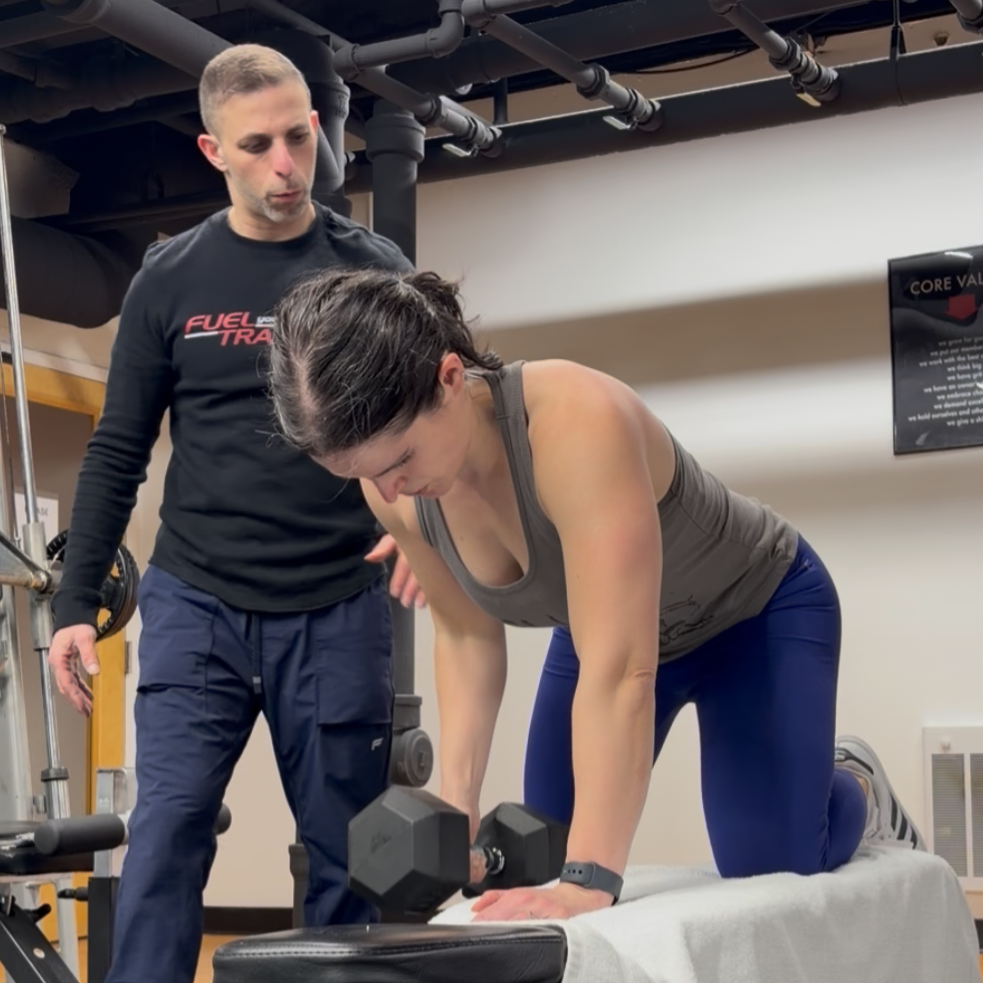
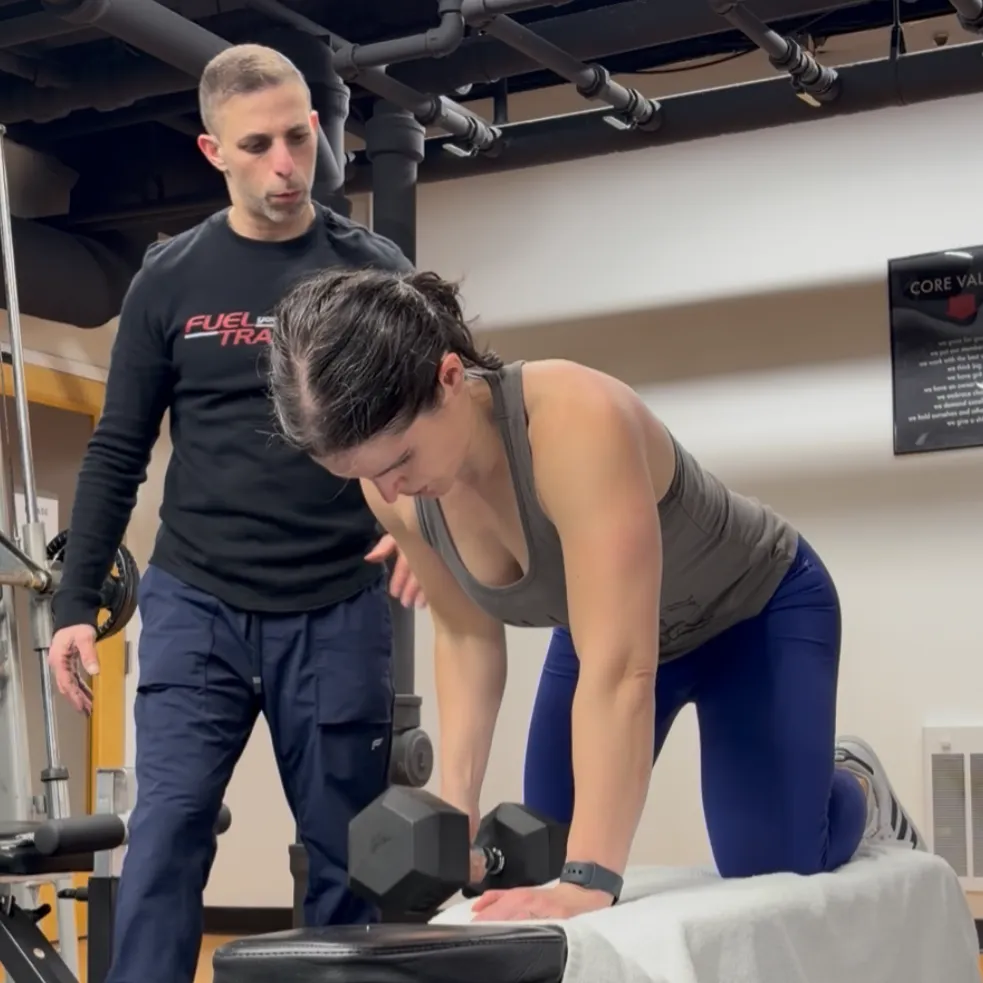
One-on-one coaching at Fuel Your Training in Northbrook, IL.
From there, early sessions tend to stay light. We use positions that let you feel your hips and trunk working, and we add load slowly. If something provokes your symptoms, we change it that day. You will not be asked to push through pain.
💡 Pro Tip: Tell your coach about symptoms the day they happen, even small ones. A tingle on Tuesday is useful information for Thursday's session.
The general ideas behind training a sensitive back
These are principles, not a protocol. Your program should be built around your own medical guidance.
Strong hips and legs take load off the spine
Much of the work in a back-friendly program goes into the hips, glutes, and legs. When those muscles do their share, the lower back does not have to. Many people with back trouble have weak hips from years of sitting.
Load goes up slowly
Tissue adapts over weeks. A jump in weight, volume, or intensity is a common reason people flare up. We change one thing at a time, so if symptoms change, we know why.
Technique beats weight
A lighter lift with a steady trunk does more for you than a heavier lift that rounds or twists. We coach the position first. Weight comes second.
Some days are lighter days
Back symptoms vary. A poor night of sleep or a long drive can change how you feel. A good program has room to scale down without calling the day a failure.
Who this may not suit
We would rather tell you now. If you are in the middle of a flare-up, have worsening nerve symptoms, or have not yet seen a physician about your back, start there. Training is a poor substitute for a diagnosis. If your doctor has told you to avoid exercise for now, we will wait with you.
If you have been cleared and want a patient, one-on-one setting, we would like to hear from you. If you want company, semi-private training with two to four people may fit later, once your movement is steady. Group fitness is coming soon, but it is not available yet.
📌 Key Takeaway: Related reading: exercise and sciatica covers leg symptoms that sometimes come with disc problems.
Frequently asked questions
Can I lift weights with a herniated disc?
Many people can, once their physician or physical therapist agrees. The program has to match your symptoms and your medical guidance.
Should I see a physical therapist before hiring a trainer?
Yes. Physical therapy is the right first step. A trainer picks up after you are discharged or cleared.
Will training make my disc worse?
Poorly planned training can aggravate symptoms. That is why we progress slowly, watch your technique, and stop or adjust when symptoms change. We cannot promise any outcome.
Does Fuel Your Training treat herniated discs?
No. We do not treat, cure, or heal medical conditions. We coach strength training for adults whose medical team has cleared them to exercise.
What does the first visit involve?
A free intro session at our Northbrook studio: a conversation about your history, a look at how you move, and a plan for what comes next. There is no obligation.
Summary
- Medical clearance comes first: Talk to your physician or physical therapist before you start.
- A coach is the next step: Strength coaching comes after physical therapy. It does not replace it.
- Go slow: Light loads, clean technique, and one change at a time.
- Report symptoms early: Small changes tell us when to adjust.
- Know the red flags: Some symptoms need urgent care, not a workout.
Book a free intro session in Northbrook
If your doctor or therapist has cleared you to train and you want a careful, one-on-one start, book your free intro session or call us at +1 312 735 1010. We are at 1430 Paddock Dr, Northbrook, IL 60062, and we serve Glenview, Northfield, Deerfield, Wilmette, Winnetka, Glencoe, Highland Park, and the greater North Shore. For rates, please call us.
This article is educational and not medical advice. Consult your physician or physical therapist before starting any exercise program.